
Blue Lake Cave: Bonito’s Underground Gem and Its Sustainability
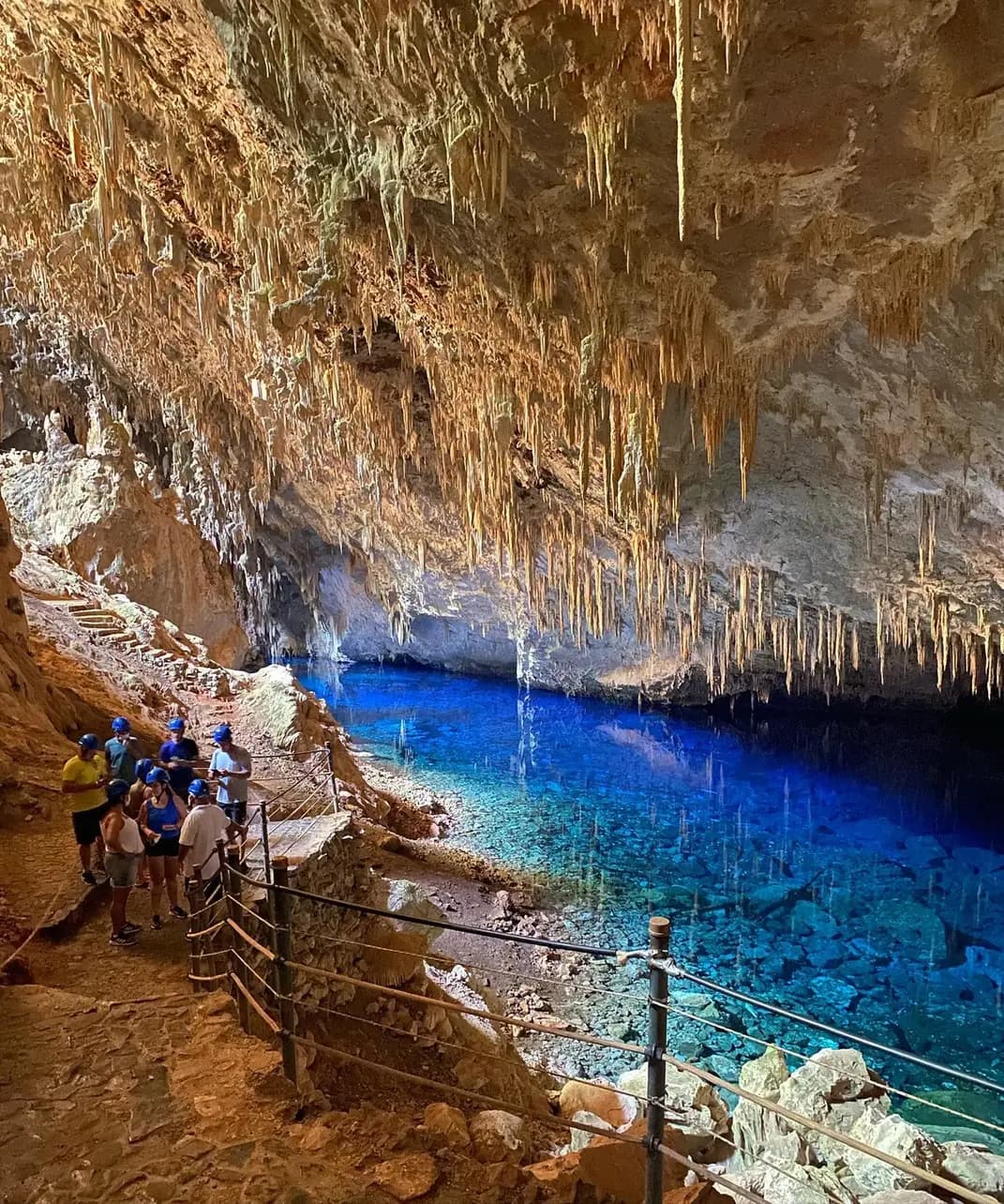
The Lago Azu Cave, located in Bonito, Mato Grosso do Sul, is one of Brazil’s most iconic natural landmarks. Internationally recognized, the cave impresses visitors with the intense blue hue of its waters, the speleological formations that cover its walls, and its scientific value. But the very beauty that attracts thousands of visitors every year is also what requires special attention to the sustainability and preservation of this heritage site.
A spectacle of nature
The intense blue color of the underground lake, which gives the cave its name, results from a physical phenomenon: the incidence of sunlight at certain times of the year and times of day. This interplay between light and mineralogy creates a visual spectacle of rare intensity. The environment also features delicate speleothems, such as stalactites and stalagmites, which bear witness to a geological process spanning thousands of years.
It is not merely an aesthetic setting: the Blue Lake Cave is also a site for scientific research, as fossilized remains of prehistoric animals have been found inside. Thus, a visit goes beyond contemplative tourism and opens the door to reflections on time, the environment, and natural memory.
Access Control: A Necessity
Precisely because of its fragility, the cave requires strict control over visitor numbers. Access is limited to 305 people per day, in groups of up to 15 visitors, with 20-minute intervals between each group. This measure is not a whim, but a strategy to reduce direct impacts on the karst environment, which is extremely sensitive to humidity, chemical variations, and even human presence.
The control model adopted in Bonito—through a single-voucher system—is one of the foundations that enables tourist visits without completely compromising the site’s integrity. Even so, long-term sustainability depends on actions that go beyond simply monitoring tourist flow.
The Challenges of Sustainability
Despite advances in Bonito’s tourism management model, the Blue Lake Cave faces critical sustainability challenges. The first of these is the absence of a formal Management Plan, which is required by law for Strictly Protected Conservation Areas. This document is essential for defining strategies for use, scientific monitoring, and long-term conservation actions.
Another area of concern is environmental education. Although visitors receive basic information during tours, there is a lack of ongoing, free programs aimed at the local population and neighboring communities. Such initiatives would be fundamental to reinforcing society’s role as guardian of a heritage that transcends regional boundaries.
A Necessary Reflection
The Gruta do Lago Azul symbolizes the paradox of sustainable tourism: how can we allow thousands of people to admire a natural asset of global significance without compromising its integrity? The answer lies in striking a balance between science, education, and public policy. Without a consistent plan, there is a risk of turning appreciation into degradation, and the opportunity for learning into mere exploitation.
Preserving the cave is not just the duty of the municipality of Bonito or tourism agencies. It is a shared responsibility among public officials, the scientific community, local residents, and visitors. Every choice—from how a tour group is led to investment in research—can impact the future of this natural monument.
Conclusion
The Blue Lake Cave is not just a tourist attraction; it is a reminder that natural beauty is intrinsically linked to its vulnerability. Recognizing its global importance also means committing to its preservation. Only through responsible management, public participation, and investments in research and education will it be possible to ensure that future generations have the privilege of experiencing this underground gem.
Next Steps
If you plan to visit Bonito, remember: your experience can be much more than just a visual feast. By choosing committed tour operators, following the guides’ instructions, and supporting conservation initiatives, you become part of the solution to preserve the Blue Lake Cave.
👉 Talk to our experts and find out how to plan your visit responsibly